


2026 is looking to be a definitive year for print marketing.
Printing is now far from being a monolithic industry and is developing into a definitive two “two-speed” markets, and it is likely to continue on this trend throughout 2026.
Digital fatigue and relentless social media ads are making print marketing materials much more appealing.
In this guide, we will walk you through the top 50 printing marketing statistics that highlight these trends and explain what it means for you and for your business.
Print Marketing Statistics: Main Highlights
- Digital Fatigue: Consumers are overwhelmed by screens, leading to higher trust and engagement rates for physical print media.
- The Phygital Shift: Combining physical print with digital tools like QR codes creates a “phygital” bridge that significantly increases campaign ROI.
- Direct Mail Dominance: Direct mail continues to outperform email marketing in response rates and open rates.
50 Printing Stats Defining 2026
Here, we’ve shifted through the top 50 print marketing statistics for 2026 and organized them to show how the digital and print industry are playing off each other.
The Impact of Digital Fatigue
The majority of us are getting fed up with digital advertising. Though we are firmly embedded into the online world, we are constantly overwhelmed and there is a growing consumer desire for authenticity and mental rest away from saturated digital channels.
Here’s how digital fatigue is affecting us:
1. 82% of consumers trust print advertisements (newspapers, magazines) when making purchasing decisions, the highest trust level of any channel (Marketing Sherpa).

2. Print media fosters 20% higher trust in brand decisions compared to digital counterparts (News by Wire).
3. Print ads require 21% less cognitive effort to process than digital media (JMF Group and True Impact).
4. Nearly 75% of consumers say they feel digitally overloaded with the number of digital ads and email they see a day. (SG360)
5. 46% of respondents say too much screen time is a major culprit of constant tiredness (PostcardMania).
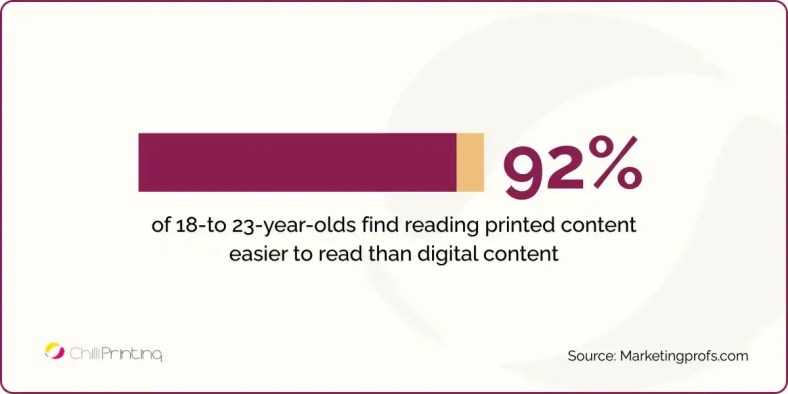
6. 92% of 18-to 23-year-olds find reading printed content easier to read than digital content (ElectroIQ).
7. Print ads achieve a 78% recall rate, whereas digital ads only reach 46% (Newsworks).
8. 70% of Americans believe that mail feels more personal than online communication. (ElectroIQ)
9. Print readers spend 20 minutes or more with their publication, compared to digital readers who typically spend less than five minutes (INMA).
10. 44% of consumers under 35 say they read all their mail before tossing it (Power Direct).
What is the Phygital approach?
From both the impact of digital marketing and the growing fatigue when it comes to online ads, a phygital reality is emerging.
Today, marketers are employing print’s tangible power to create a physical touchpoint that acts as a bridge to digital actions like website visits.
Here’s how it evolving:
11. Online campaigns were 400% more effective when combining print and digital advertising (Top Media Advertising).
12. Marketing campaigns combining direct mail and digital media see a 118% lift in response rates compared to digital-only efforts (Resimpli).
13. The number of US smartphone users scanning QR codes is projected to rise to 102.6 million by 2026 (QRCodeChimp).
14. 97% of businesses incorporate digital links like QR codes in their printed direct mail at least occasionally (Keypoint Intelligence).
15. 37% of consumers are likely to scan a QR code on direct mail (Porch Group Media).
16. 60% of catalog recipients visit the brand’s website (Walsworth).
17. 44% of customers visit a brand’s website after receiving direct mail, which is 10% more than those receiving an email (Cascade Print Media).
18. When primed by mail, people spent 30% longer looking at ads on social media (JIC Mail).
19. Variable Data Printing (VDP), a key phygital technology, is projected to reach $16.87 billion globally in 2026 (Zion Market Research).
20. 89% of marketers agree that print marketing complements digital campaigns effectively (ZipDo).
Direct Mail Marketing Statistics
This section highlights the superior performance of direct mail and personalized print campaigns over digital equivalents.
Data shows they perform better particularly in terms of engagement, response, and ROI.
21. The average response rate for direct mail campaigns is 4.4%, compared to 0.6% for email campaigns (ZipDo).
22. Direct mail marketing delivers the highest average ROI of any channel, reaching 112% (VPress).
23. The average response rate for printed direct mail is 37% higher than email direct marketing (Cascade Print Media).
24. 80-90% of direct mail is opened, while only 20-30% of emails are opened (Cascade Print Media).
25. 84% of marketers agreed in 2024 that direct mail provides the highest ROI of any channel they use. (Resimpli)

26. The US direct mail industry is projected to reach a market value of $73.57 billion by 2026 (The Business Research Company).
27. 76% of marketing teams reallocated funds from digital to direct mail specifically due to rising data privacy concerns (RRD).
28. Adding a name to direct mail increases response rates by 135% (Resimpli).
29. The response rate for personalized direct mail is 2.7%, which is higher than the average digital campaign (ZipDo).
30. Direct mail accelerates the purchase process: 73% of purchase decisions take only 1+ day with direct mail (Postanalytics).
Brochures & Flyers Statistics
Brochures and flyers fall under the category of physical marketing tactics that build local awareness and drive sales. They are highly valued by small business owners and consumers alike.
31. 71% of small business owners say physical marketing tactics like flyers are important for connecting with customers (PostcardMania).
32. Roughly one-third (34%) of consumers report discovering a small business through flyers (Wix and VistaPrint).
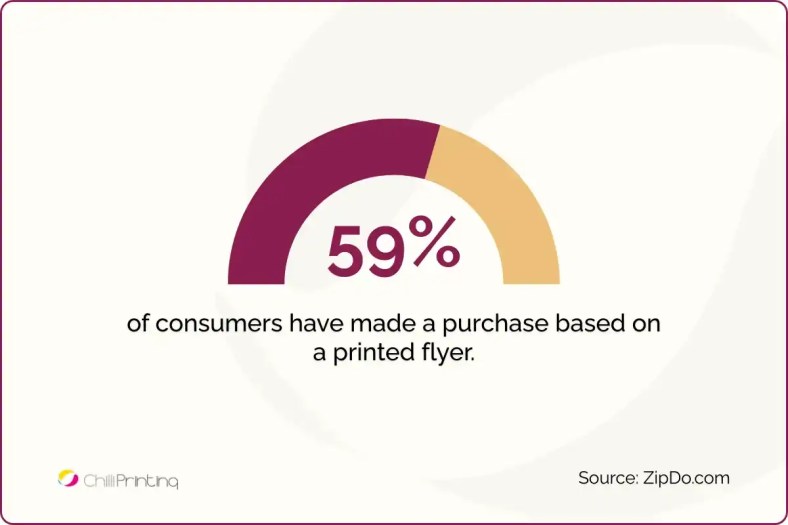
33. 59% of consumers have made a purchase based on a printed flyer (ZipDo).
34. 60% of small businesses plan to use direct mail marketing in the next year (Taradel).
35. Small businesses blending in-house marketing with external services report 2.5X more marketing success (SimpleTexting).
36. 78% of consumers say it’s important for them to shop small (Wix and VistaPrint).
37. 66% of marketers report that print marketing is effective for local advertising (ZipDo).
38. 80% of local businesses use some form of print marketing (ZipDo).
39. Small businesses with a marketing plan reported 87% success, compared to 13% for those without one (SimpleTexting).
40. The North America sustainable printing market includes the segments of Flyers/Brochures and Booklets. (Grand View Horizon)
Design your custom brochure today.

Statistics About Posters
Posters, banners, and large format printing are vital for local visibility and retail sales. They remain a key tool for driving high-impact brand awareness.
41. 37% of consumers visited a local business after seeing outdoor signage or posters (Wix and VistaPrint).
42. 23% of consumers find small businesses through posters/banners (Wix and VistaPrint).
43. 71% of small business owners consider physical marketing materials important for connecting with customers (PostcardMania).
44. 60% of retail stores use in-store printed signage to increase sales (ZipDo).
45. Large-Format Printing is growing at a healthy rate because of increased demand for long-life outdoor advertisements.
46. 89% of marketers say printed marketing materials effectively generate brand awareness (Allegra & Ascend2).

47. 68% of marketers say print marketing helps increase brand awareness (ZipDo).
48. The physical nature of print signals professionalism, thereby improving brand reputation (Print Impressions).
49. The most valuable leads for small business owners include referrals (25.7%) and in-person consultations (22.5%) (Taradel).
50. 78% of consumers find print ads more aesthetically pleasing than digital ads (ZipDo).
Design a poster that captures attention

What Are the Current Print Marketing Trends for 2026?
The core finding defining the landscape for 2026 is that the industry is not monolithic. It has split into two separate markets.
The first is legacy platforms undergoing decline, and the second is strategic segments like direct mail and packaging. This structural shift is largely powered by consumer fatigue with digital overload.
The US commercial printing market projects growth at a 3.1% Compound Annual Growth Rate (CAGR) from 2025 to 2030.
This growth is a net-positive calculation where losses from legacy publications are outweighed by growth in high-demand segments.
Read More: What Does Paper Weight Mean?
Legacy media platforms including linear TV and radio will revert to secular declines in 2025 and 2026. However, the strategic print marketing sector is experiencing a data-driven renaissance.
In the B2B sector, trade magazine print ad revenue is forecast to see a negative 3.2% CAGR. In contrast, out-of-home (OOH) advertising is projected to surpass print and become the third-largest advertising format globally by 2026.
Are Print Materials Effective in 2026?
Print materials remain an incredibly effective tool for marketers and will have a major impact on how we do marketing in 2026.
The effectiveness is especially most evident with direct mailing.
According to Miller Bernstein, 80% of consumers act on direct mail marketing. This represents a “37% higher rate than from email marketing”.
A compilation of statistics by Postcard Mania based on a RRD report backs this up, indicating that people spend 45% longer engaging with direct mail vs digital ads.
Magazines and newspapers are not the only effective formats. Flyers and brochures remain vital for small businesses to build local awareness.
The U.S. is expected to become the first major market where digital newspaper ad revenue exceeds print newspaper ad revenue by 2026.
Yet, the trust factor of the physical format remains superior.
So yes, print materials are still very effective when it comes to cutting through the digital noise.
What Is the “Phygital” Bridge?
The fusion between the physical and the digital world has been an emerging reality within the last few years.
This new “phygital” reality blends on-screen and off-screen experiences to increase effectiveness.
Print marketing significantly increases conversion when combined with digital advertising.
Studies show that digital advertisements are four times more effective when they complement print materials.
This trend is largely supported by the integration of QR codes within printed pieces. A simple scan on a postcard connects the physical user to a digital landing page.
What About Privacy?
Another important factor that makes print marketing more important is the rising concern for privacy. Data collection by organizations is under more public and government scrutiny.
Companies are increasingly synthesizing their campaigns to build trust through the tangible nature and perceived security of print materials. Print offers a way for customers to avoid being tracked online.
Many marketing teams are reallocating funds to brochure printing and direct mail specifically to address these privacy concerns.
The Verdict: Where Is the Print Industry Going in 2026?
The print industry is going through a resurgence driven by digital fatigue. It is an excellent opportunity to take advantage of the current situation.
While legacy formats like newspapers may struggle with ad revenue, the commercial side of printing is thriving. The shift toward “phygital” marketing proves that print is not dead; it is evolving.
Smart businesses will use print to build trust and cut through the noise. 2026 will be the year where print reclaims its place as a premium marketing channel.
Print Your Marketing Materials With ChilliPrinting
ChilliPrinting is your trusted partner for high-quality online printing solutions. We specialize in helping businesses navigate the “two-speed” market with cost-effective, professional print products.
We provide a vast range of printing product choices for small to medium-sized businesses looking for high-quality flyers, leaflets, brochures, and booklets at the right price.
Impress your customers with custom branding


