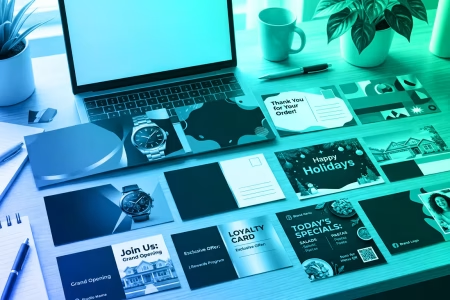

When you’re starting a new business, marketing is one area that requires investment. From business cards to brochures, posters to social media, it’s important to use all options at your disposal.
While much of the focus has been on digital marketing and print marketing campaigns continue to be extremely important.
However, a mistake on your print materials can prove costly and time-consuming. Here are the 9 most common print marketing mistakes and how to avoid them.
1. Trying To Do It All Yourself
One common mistake for new business owners is trying to manage every technical aspect of printing alone.
Modern design platforms make layout easier than ever, but preparing files for physical print still requires specific knowledge. Investing in an online printing shop or professional prepress designer ensures you create high-quality products on the first try.
Printing services guide you on the best formats and offer stock upgrades or specialty coatings that elevate your final product. Using a professional service for the final production stages saves time and prevents expensive re-prints.
2. Not Doing Sufficient Market Research
You need a clear idea of your target audience and what appeals to them. Invest time researching the copy, fonts, graphics, and images you intend to use. Do they appeal to your target market? Are they delivering the right message? If not, you have the opportunity to pivot before spending money on physical materials.
3. Relying on Generic Stock Images
Using generic stock photography is a major misstep. If you use a standard stock image, your competitors likely use it too. Instead, aim for unique visuals.
If you provide a service, sharing before and after pictures provides authentic visual proof of your impact. Today, you can also use generative AI tools to create hyper-specific, unique commercial images for a fraction of the cost of a traditional photoshoot.
Whether you hire a professional photographer or leverage modern AI tools, ensure your images tell a compelling story.
4. Not Understanding Image Formats
The image format and color profile make a massive difference to your campaign. A low-quality, pixelated image makes your marketing stand out for all the wrong reasons. Image formats like PNG or JPG might look crisp on a screen, but printed versions require high-resolution files.
The color format for printed products also differs from a computer screen, requiring CMYK formatting instead of RGB. Always test your designs in print before funding a large campaign.
5. Ignoring Technical Print Elements
Depending on the print marketing materials you want to create, you have to consider various technical requirements. Brochures, catalogs, and posters come in different sizes that impact your formatting.
Business cards come in different styles and coatings that affect durability. You also need to leave at least 3mm around every side of your design for the bleed. For complex designs, increasing this to 4 to 6mm prevents your artwork from being cut short. Working closely with a dedicated print shop provides guidance on these formatting rules.
Read more: Aqueous Coating Explained: Types, Examples & Benefits
6. Failing To Link To Digital Content
Print marketing is most effective when it directly bridges to your digital presence. Simply listing a website URL is no longer enough. Dynamic QR codes are now a universal standard, allowing customers to instantly connect to your business while giving you the ability to track scan data and update destination links after printing.
You can even explore NFC tags for high-end business cards or augmented reality integrations to bring physical flyers to life on a smartphone screen.
7. Creating A Design That Is Too Busy
It is tempting to use up as much space as possible to communicate with your target audience. This usually backfires and results in visual overload. The result is a campaign that is messy, difficult to decipher, and ultimately ineffective.
White space is a powerful tool in print marketing. It makes your campaign more accessible and easier to read. Your design should be attractive, clear, and concise. All elements must follow the same theme and support one another.
8. No Clear Call-To-Action
If your print materials lack a clear call-to-action (CTA), they are a waste of resources. Identify your core goal and make it obvious to your audience. Stick to one very specific CTA and be direct about what you want people to do. The CTA must be immediately visible and lead straight to a goal, whether that is a digital sale, a phone call, or a social media connection.
9. Failing To Proofread
Even the most beautifully designed campaign instantly loses credibility if you fail to proofread it. Spelling and grammar mistakes show a lack of attention to detail that customers rarely forgive.
Always check the copy before sending anything to the printer. Ask a colleague to review the text and run your final drafts through modern AI writing assistants or advanced proofreading software to catch any lingering errors.
Why Choose ChilliPrinting As Your Printer
ChilliPrinting is an online printing company providing small business owners with top quality printing materials. With over 15 years of experience, we specialize in offset printing with a fast turnaround on bulk orders from the smallest flyers to premium posters.
We offer:
- Premium Print Quality: Vibrant colors and crisp text on top-tier paper stocks. Our advanced offset presses make your flyers, posters, and brochures impossible to ignore.
- Lightning-Fast Turnaround: Our optimized production ensures your bulk orders arrive exactly when you need them.
- Real Human Support: Need help prepping artwork or adding custom QR codes? Our dedicated print experts are with you every step of the way.
Ready to go? Choose your preferred print product or reach out to our team today!